
Schleicher County Court Records After Arrest
The first record after a local arrest is usually a jail booking record at the Schleicher County Jail, operated by the Schleicher County Sheriff's Office. That booking record can identify custody status, arresting agency, booking date, bond, and the charge as it reached the jail. It is not the full court record. Court records after a Schleicher County jail arrest start to take shape when the County Attorney, 51st District Attorney, clerk, or court receives formal paperwork and opens a criminal case.
Schleicher County uses a small local records structure. Marsha L. Maskill is listed as County and District Clerk on the official County Clerk and District Clerk pages. County-level misdemeanor routing can involve County Attorney Clint T. Griffin, while felony and district-court prosecution routes to 51st District Attorney Allison Palmer. The 51st District Court serves Coke, Irion, Schleicher, Sterling, and Tom Green Counties, and the local judge page names Judge Carmen Symes Dusek for that district court.
For current custody and booking details, use the Schleicher County jail inmate records path first. For booking photos, use the Schleicher County jail mugshots path. Court records after an arrest answer a different question: what charge was filed, which court has it, whether it is pending, amended, dismissed, or disposed, and whether the case has a bond, warrant, plea, or judgment entry.
Schleicher County Case Channels
The official county site does not provide a single public portal that replaces the clerk, prosecutor, JP, jail, and statewide tools. The practical path is to start with the office that holds the record type. A fresh arrest may still be known mainly to the sheriff's jail. A filed misdemeanor may sit with the County/District Clerk and County Attorney. A felony may be routed through the District Clerk, 51st District Court, and 51st District Attorney.
The clerk's office is the main local court-record contact. The official county pages list Marsha L. Maskill at P.O. Drawer 580, Eldorado, TX 76936, phone 325-853-2833, and fax 325-853-2768. For prosecution questions, the county attorney page lists Clint T. Griffin at P.O. Box 506, 2 S. Divide, Eldorado, TX 76936, phone and fax 325-853-2594. The Justice of the Peace page lists Judge Rahegyn Franke, phone and fax (325) 853-2766, and email jp.scco@co.schleicher.tx.us for JP-level matters.
| Record Need | Best Starting Point | Why It Matters |
|---|---|---|
| Current custody after arrest | Sheriff or jail at (325) 853-2737 | The county has no official online roster, so phone confirmation is the first local source. |
| Filed misdemeanor case | County/District Clerk and County Attorney | The clerk can route case-number questions, while the county attorney handles county-level prosecution. |
| Felony or district case | District Clerk, 51st District Court, 51st District Attorney | Felony charging and settings may move through the district-court structure. |
| Class C warrant or hold | Justice of the Peace and OmniBase | The JP page links OmniBase for active Texas Class C misdemeanor warrant checks. |
Find Schleicher County Court Records
Search work should start with a few fixed facts: the person's full legal name, date of birth if known, arrest date, booking date, charge name, and any case number the jail or clerk gives. If the arrest is recent, a court case may not appear immediately. That gap does not mean the arrest did not happen. It often means the booking record exists before the filed court record is indexed or available to the clerk counter.
- Call the sheriff's office or jail at (325) 853-2737 to confirm whether the person was booked locally and whether a booking date, charge, bond, or case number is available.
- Contact the County/District Clerk and ask whether a criminal case has been filed under the defendant's name. Give the arrest date and charge if known.
- For felony or district-level matters, ask about District Clerk and 51st District Court routing. For county-level misdemeanors, ask about county clerk and county attorney routing.
- Check re:SearchTX if electronic court access is needed. Coverage varies, and account access may be required.
- Use Texas DPS Crime Records Services for statewide criminal-history channels, not for a county jail roster.
The statewide court and DPS tools should be used carefully. re:SearchTX is a court-record access portal, not a Schleicher County jail roster. DPS criminal history is broader than a single county case file and may have its own account, fee, or eligibility rules. When a record is needed for court, employment, licensing, immigration, or another high-impact use, confirm the record with the clerk or the agency that created it.
The official County/District Clerk page is the local source for clerk contact routing. The screenshot below shows the kind of official county contact page to use before relying on third-party case summaries.
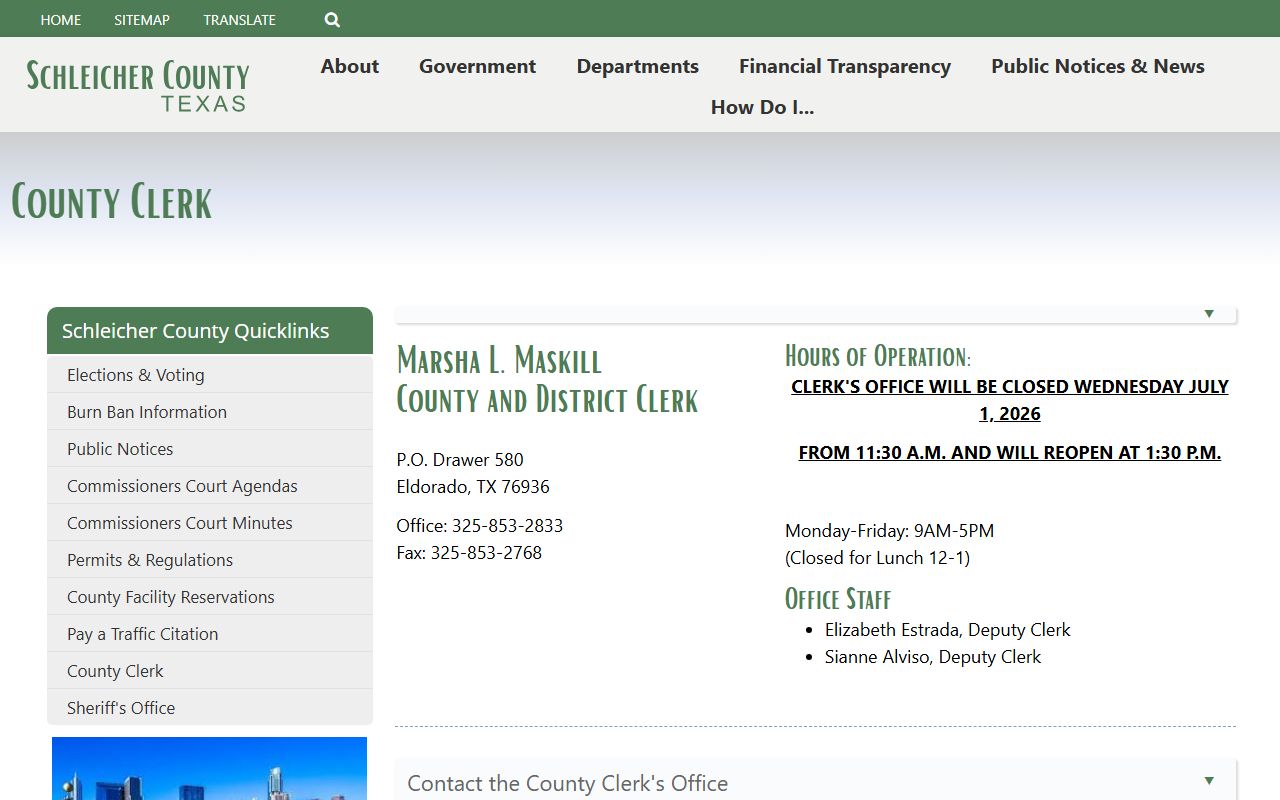
Use the clerk contact information to ask for the exact court, case number, and filing status tied to a Schleicher County arrest.
Schleicher County re:SearchTX Fields
Electronic court search can help when a case has been indexed, but it should not be treated as complete local custody proof. re:SearchTX may require a login or an account, and access can depend on court participation, user role, record type, and restriction rules. If a case is missing online, the next step is the clerk, not a commercial people-search site.
| Field Label | Type | Required | Options or Notes |
|---|---|---|---|
| Login/account | account access | may be required | Portal access can depend on user role and record type. |
| Party/Name search | text | optional | Use defendant name where records are available. |
| Case number | text | optional | Best if the clerk provides the exact local case number. |
| County/court | filter/dropdown | optional | Select the court or county where available. |
| Date range | date/filter | optional | Useful for recent arrests and common names. |
| Search | button | N/A | Runs the search. |
The statewide re:SearchTX portal can be a useful next stop after the clerk or case number is known.
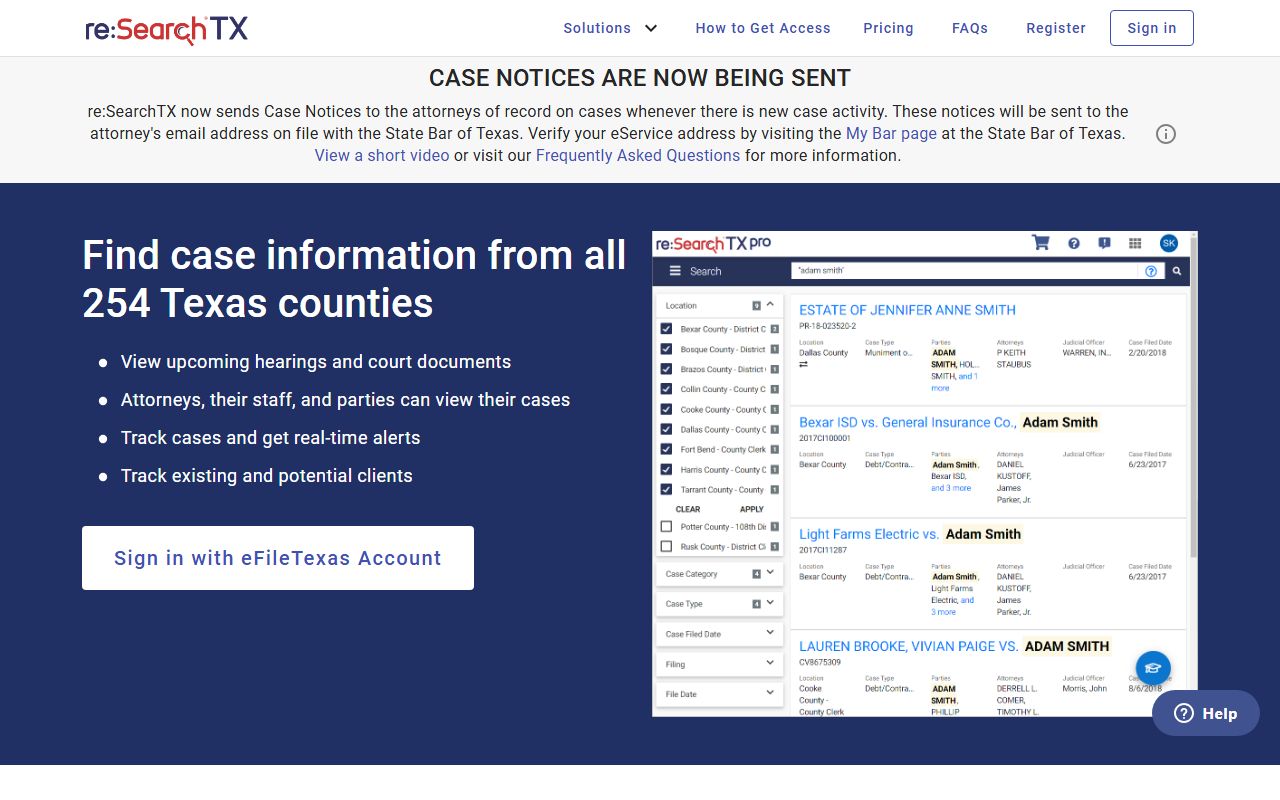
When electronic results conflict with clerk information, the local clerk or the court that filed the entry should control the next step.
Charging Documents After Arrest
Court records after a Schleicher County jail arrest usually turn on a charging document. Booking starts the jail record. The charging document starts or formalizes the court case. Texas cases can use a complaint, an information, or an indictment depending on the offense level and procedural posture. The research did not locate a county-specific filing manual, so the safest wording is the general Texas path: arrest, booking, magistration, prosecutor review, formal charge, court filing, settings, and disposition.
| Document | Who Usually Drives It | Common Use | What to Check |
|---|---|---|---|
| Complaint | Officer, prosecutor, or sworn complainant | Can start a misdemeanor or preliminary criminal matter. | Name, date, alleged offense, court, and warrant or arrest link. |
| Information | Prosecutor | Formal accusation often used without a grand-jury indictment where allowed. | Filed charge, offense level, prosecutor signature, and amendments. |
| Indictment | Grand jury | Many felony prosecutions. | Count numbers, offense wording, date filed, and district-court routing. |
A jail charge can change before filing. It can be reduced, amended, dropped, or replaced by a different charge after prosecutor review. That is why a court-record search should never rely only on the charge name heard at booking. Ask for the filed charge, court, case number, and current status.
Schleicher County Charge Status
Charge status is the part of a court record that tells whether the case is open, changed, closed, or resolved. A fresh arrest may show a hold or bond at the jail while the case is still awaiting filing. After filing, the clerk and court record may show pending settings, amendments, dismissal, plea, deferred adjudication, acquittal, conviction, or another disposition.
| Status | Plain Meaning | Why It Can Differ From Booking |
|---|---|---|
| Pending | The case is open and not finally resolved. | The jail may still show custody or bond while court dates continue. |
| Filed | Formal charge paperwork has been opened with the court or clerk. | The filed charge may not match the first booking label. |
| Amended or reduced | The prosecutor changed or lowered the charge. | Early arrest wording may remain in older jail paperwork. |
| Dismissed | The charge ended without a conviction on that charge. | A booking record may still exist unless it is later expunged or restricted. |
| Indicted | A grand jury returned felony charge paperwork. | The district case may appear after the original jail booking. |
| Disposed | The case has an outcome, such as plea, conviction, dismissal, deferred adjudication, or acquittal. | The court record, not the jail roster, is the outcome source. |
Note: A charge is an accusation, and a conviction is a final court outcome after a plea or adjudication.
Bond After Jail Arrest
Bond information can sit in both jail and court channels. Under Texas Code of Criminal Procedure Chapter 17, bail rules address appearance, offense nature, ability to pay, and safety. In Schleicher County, the sheriff's office may be able to report a current bond amount or hold status, but later bond changes may be found in the court case. The county site does not publish a bond window, payment list, online bond vendor, or bail schedule, so call the jail before attempting to post bond.
| Bond Type | How It Works |
|---|---|
| Cash bond | The full cash amount is posted with the authorized official, subject to court rules and fees. |
| Surety bond | A licensed bail bondsman posts the bond and guarantees court appearance. |
| Personal or PR bond | The person signs a promise to appear, often with conditions set by a magistrate or court. |
| Property bond | Property may secure release if allowed and accepted by the proper court process. |
| No-bond hold | Release is not available on that charge or hold until a court or agency clears it. |
| Detainer or agency hold | Another county, parole, federal, or immigration agency may block release even if local bond is posted. |
Arrest Warrants and Court Records
A warrant can be the reason a person enters the Schleicher County Jail, but there is no official sheriff-run online active warrant list in the research. The JP page links OmniBase for active Texas Class C misdemeanor warrant or license-hold checks. That is a limited JP/Class C channel. It is not a full felony warrant database and should not be read as a complete list of every warrant tied to Schleicher County court records.
For warrant-related court records after arrest, start with the issuing court when known. JP-level failure-to-appear matters can route to Judge Rahegyn Franke's office. District-court bench warrants and felony matters route through the district clerk and 51st District Court channels. Custody questions still start with the jail. If a person may have an active warrant, call before appearing in person because some warrant contacts can lead to arrest.
Charges Versus Convictions
Schleicher County court records after arrest may show accusations long before they show an outcome. A charge means the government alleges an offense. It does not mean guilt. A conviction means the court has entered guilt after a plea, verdict, or other qualifying disposition. Deferred adjudication, dismissal, and acquittal need their own careful reading because each affects the record in a different way.
| Point | Charge | Conviction |
|---|---|---|
| Stage | Accusation after arrest, complaint, information, or indictment. | Final adjudication of guilt after plea, verdict, or court action. |
| Proof level | Based on probable cause or prosecutor filing review. | Requires a plea or proof beyond a reasonable doubt. |
| Record effect | Can appear in court records even if later dismissed. | Can affect sentencing, criminal history, licensing, and supervision. |
| Where to confirm | Clerk file, prosecutor filing, and court docket. | Judgment, sentence, disposition, and DPS criminal-history channels. |
Sealed and Expunged Arrest Records
Some arrest and court records are restricted by law, order, or case type. Texas expunction law is found in Code of Criminal Procedure Chapter 55. Expunction can apply to qualifying arrest records, but it is not automatic for every dismissal and it does not erase every record without the required order. Texas also has nondisclosure concepts that can limit public access in some settings, but the research source specifically identified expunction as the statute to use here.
| Point | Sealed or Restricted | Expunged |
|---|---|---|
| Public visibility | Hidden or limited for many public searches, depending on the order. | Removed or treated as not publicly available under the expunction order. |
| Agency access | Some agencies may retain limited access where law allows. | Access is very limited and controlled by the expunction order. |
| Eligibility | Depends on case type, disposition, and Texas law. | Depends on Chapter 55 and the facts of the arrest or case. |
| How to confirm | Ask the clerk for the order and current public-access status. | Ask the clerk whether an expunction order was signed and sent to agencies. |
DPS and Background Checks
DPS Crime Records Services is a statewide criminal-history channel. It is not the same as a Schleicher County jail booking sheet, clerk file, or prosecutor case record. A statewide search can help verify criminal-history information, but any disputed charge status should still be checked against the court that created the record. If a person was moved to state prison after sentencing, TDCJ is the custody source rather than the county jail.
Important: This reference is not a consumer reporting agency and must not be used for employment, tenant, credit, insurance, or other FCRA-covered decisions.
Restricted Schleicher County Court Records
Texas public access starts with Government Code Chapter 552, the Public Information Act, but exceptions and redactions can apply. Juvenile records, sealed cases, expunction matters, sensitive victim information, ongoing investigations, medical or mental-health details, and some law-enforcement material may be withheld or released only in limited form. A clerk or agency can also require a written request that describes the record with enough detail to locate it.
For a narrow request, give the person's full name, date of birth if known, arrest date, booking date, court, charge, case number, and the specific record sought. Broad requests are slower and more likely to miss the record. The same rule applies across the sheriff, clerk, JP, county attorney, and district attorney channels: ask for the specific court record after arrest, not every document connected to a name.